
Download this gravity in space booklet to introduce your students to gravity and galaxies.
Use this booklet when working on gravity in space, galaxies, and star formation.
This is another free resource for teachers and homeschool families from The Curriculum Corner.
About this booklet
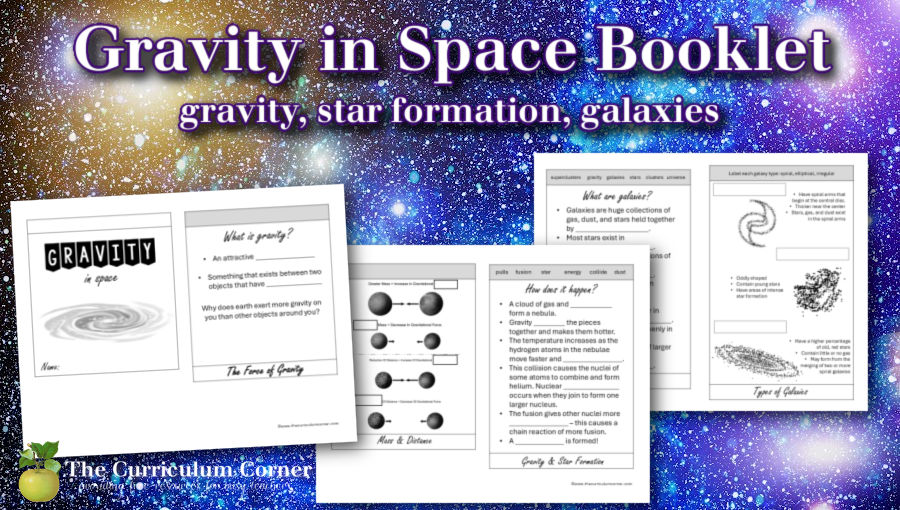
This booklet was designed to review gravity and connect it with galaxy formation. It is a quick overview – not an in-depth resource.
Along with reviewing the laws of gravity, students will complete a fill-in-the-blank page about star formation.
Also included is a fill-in-the-blank about galaxies and a page where students label the types of galaxies.
This was a booklet we used after students had begun working with the vocabulary for the unit of study. You will find the free vocabulary set I used for this here: Universe Vocabulary Cards & Quiz.
Once students had worked on these words, they were able to work on the booklet. If the concepts of gravity in space and star formation are new, there were many different short videos on YouTube to use to help.
When students have finished the booklet, have them cut apart the pages and create a flip booklet. So often we think of this as busy work for older students. However, I have found that so many of my 6th graders are in need of the fine motor practice.
I had students add the completed booklet to their science notebooks.
Answer Key
What is gravity?
An attractive force.
Something that exists between two objects that have mass.
Why does earth exert more gravity on you than other objects around you?
It has more mass
Mass & Distance
Greater mass = increase in gravitational force
Less mass = decrease in gravitational force
reduction of distance = increase of gravitational force
Increase of distance – decrease of gravitational force
Gravity & Star Formation
How does it happen?
A cloud of gas and dust form a nebula.
Gravity pulls the pieces together and makes them hotter.
The temperature increases as the hydrogen atoms in the nebulae move faster and collide.
This collision causes the nuclei of some atoms to combine and form helium. Nuclear fusion occurs when they join to form one larger nucleus.
The fusion gives other nuclei more energy – this causes a chain reaction of more fusion.
A star is formed!
What are galaxies?
Galaxies are huge collections of gas, dust, and stars held together by gravity.
Most stars exist in galaxies.
There are hundreds of billions of galaxies in the universe.
A single galaxy can contain hundreds of billions of stars.
Galaxies are held together in groups called clusters. They are not spread out evenly in the universe.
Most clusters are a part of larger structures called superclusters.
Types of Galaxies
Spiral galaxies: have spiral arms
Irregular galaxies: oddly shaped
Elliptical galaxies: have a higher percentage of old, red stars
You can download this free booklet by clicking on the green apples below:


As always, this is a free resource for teachers and homeschool families. It is intended for free classroom use. It may be copied and used as is. It may not be sold or modified and sold in any way.