Energy Flow in Ecosystems Booklet
This Energy Flow in Ecosystems Booklet helps students learn about food webs and food pyramids.
Students will begin to explore the energy flow in ecosystems while completing this booklet.
This is another free resource for teachers and homeschool families from The Curriculum Corner.
About this booklet
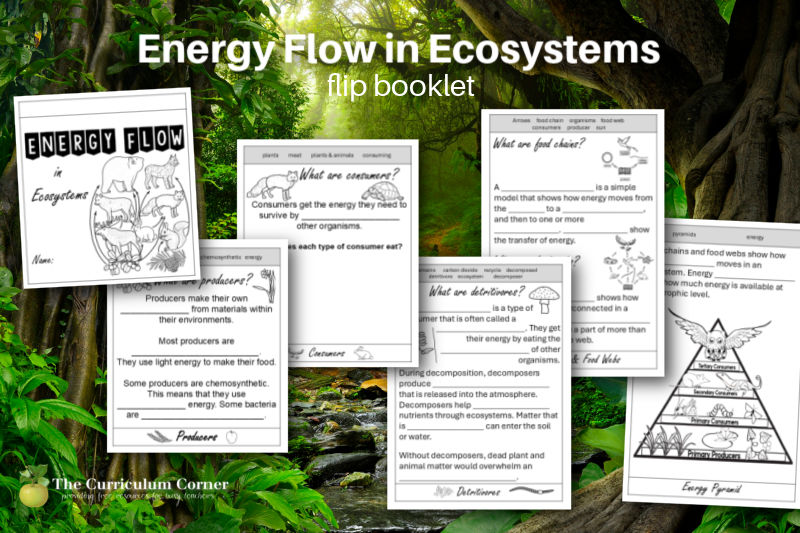
This booklet is designed to teach students how energy moves through an ecosystem.
The following wording is included in this booklet:
What are producers?
Producers make their own energy from materials within their environments.
Most producers are photosynthetic. They use light energy to make their food.
Some producers are chemosynthetic. This means that they use chemical energy. Some bacteria are chemosynthetic.
What are consumers?
Consumers get the energy they need to survive by consuming other organisms.
What does each type of consumer eat?
carnivore – meat
herbivore – plants
omnivore – plants & animals
What are detritivores?
A detritivore is a type of consumer that is often called a decomposer. They get their energy by eating the remains of other organisms.
During decomposition, decomposers produce carbon dioxide that is released into the atmosphere.
Decomposers help recycle nutrients through ecosystems. Matter that is decomposed can enter the soil or water.
Without decomposers, dead plant and animal matter would overwhelm an ecosystem.
What are food chains?
A food chain is a simple model that shows how energy moves from the sun to a producer, and to one or more consumers. Arrows show the transfer of energy.
What are food webs?
A food web shows how food chains are interconnected in a community. Some organisms in a food web can be a part of more than one food chain in the web.
Food chains and food webs show how energy moves in an ecosystem. Energy pyramids show how much energy is available at each trophic level.
Creating the booklets
This booklet is designed to be printed single-sided.
I gave students the pages in a stack and had them add their name to each page. I have found that it is easier for students to work on and keep track of pages before they cut them out.
Often, students could think through and find the answers on their own without a source. When needed, they were allowed to use their science books or find the answers on-line.
To assemble, students cut out the pages. The gray spots at the top of each page need to stay attached. The gray shows students where they will add glue. The pages are stacked together, and the flip book is created.
In my class, students glued the flip book into their science notebooks to use as a reference.
You can download this set by clicking on the green apples below:
As always, this is a free resource. This can be copied for schools and homeschool families. It may not be sold or modified and sold in any way.